Posted by Robin
on
9 March 2010

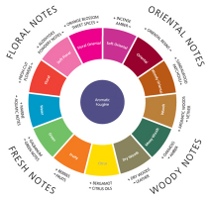
Fragrance families cause a good deal of confusion, even among seasoned perfumistas. Two experiences, both involving the fruity floral category, illustrate the problem.
I once got a rather unpleasant email from a reader who was angry that I called a fragrance a “fruity floral” in a new fragrance announcement: she assumed that I was making an arbitrary assignment based on the notes listed in the press release, and that I was trying to make a critical statement about this particular fragrance.1 This nicely introduces the first point I’d like to make about fragrance families: you cannot determine the fragrance family by reading a list of notes. If you see a fragrance family listed in a new fragrance announcement, it came from the press materials or some other primary source.
Some time later I held a poll asking readers to name their favorite fruity floral perfumes. While most of the suggestions were, in fact, fruity, a rather large percentage of them were not, in fact, fruity florals. And that introduces the second point I’d like to make: you cannot determine the fragrance family just by the noticeable presence of certain notes, either…
Read the rest of this article »
Posted by Robin
on
29 September 2009

One of the many hazards of writing about perfumes is that they’re not static objects. If you pick up a new bottle of Jean Couture Coriandre, what you’ll smell won’t be at all what I smelled when I first bought it in the late 1970s. It might not even be the same as what I smelled when I reviewed Coriandre a couple years ago, and found it to be an entirely different animal than the scent I remembered. The Coriandre you smell tomorrow, or next month, or next year, might have changed yet again.
This has obvious implications for anyone blogging about perfume or reading perfume blogs. When you read a perfume review, unless it’s about a perfume that launched recently, you can’t be sure that what you’ll smell in the stores is the exact same fragrance.
This article is meant as a very basic primer on reformulation, and most of what I’ll cover is well-known to seasoned perfumistas.
Perfumes get reformulated all the time, and they always have. Why? Well, there are any number of reasons. Sometimes companies substitute cheaper ingredients as a cost-saving measure…
Read the rest of this article »
Posted by Angela
on
17 August 2009
Not long ago I was talking to the owner of a vintage clothing store. I asked her to be on the lookout for old bottles of perfume (hey, an enterprising gal is a gal with an lifetime supply of Fabergé Tigress). She told me she finds lots of perfume at estate sales, “But you wouldn’t want it. It’s old. It’s nasty,” she said and wrinkled her nose.
Yikes! How many bottles of Jean Patou Joy or vintage Worth Je Reviens had she left behind? She might have passed up some of the perfume because she’s not used to smelling a powerhouse vintage perfume, but she probably figured that anything old is likely to have spoiled. It’s time to nip these kinds of heartaches in the bud and lay out a few of the biggest misconceptions about perfume:
1. Perfume goes bad over time. Perfume can sour, but it’s usually sunlight and heat that destroy it, not time. Put a bottle of your favorite, brand new perfume on the dashboard of the car for a few weeks in summer and keep another bottle in its box in a drawer and you’ll learn this lesson firsthand. It doesn’t matter how expensive, or cheap, the perfume was…
Read the rest of this article »
Posted by Robin
on
14 November 2008

There are lots of articles on Now Smell This to help you get started, and I've also included some links to helpful information on other websites. Readers, please comment and add your best advice!
You're really brand new, and have no idea what anyone is talking about…
Start by reading the frequently asked questions. After that, you might take a peek at the glossary, then learn a bit about the basic building blocks of fragrance by reading on lists of fragrance notes, why they matter & why they don't and getting to know fragrance notes. If all of that starts to seem overwhelming, reading how much perfume knowledge is too much? might help you put things back into perspective.
Of course, you'll need to find some perfumes to smell, so take a look at our primer on how to get fragrance samples, free or otherwise. You might also want to learn more about how to apply perfume, and in case that new perfume isn't working for you, you'll need to know how to remove fragrance from skin.
You're learning more, but still worried your taste isn't up to snuff? Please read de gustibus non est disputandum ~ random thoughts on perfume snobbery.
If all of that wasn't enough, it's time for a trip to your local library or bookstore…
Read the rest of this article »
Posted by Robin
on
21 July 2008

One of the many obstacles facing perfume consumers today is how to go about finding fragrances they might like in the great sea of new releases. As I've written in the past, reading the list of fragrance notes for a given perfume can be misleading, but sometimes it's about all you have to go on other than the ad visuals or celebrity sponsorship. Just because you find Jude Law sexy as all get out, it doesn't mean you're going to love Dior Homme Sport; likewise, just because you like jasmine and saffron, it doesn't mean Ungaro by Ungaro is going to appeal to you.
Still, it helps to know a little something about fragrance notes. Most of us have neither the time nor the inclination to smell absolutely everything. Figuring out which notes you find attractive and which you detest can at least help you to narrow down your choices…
Read the rest of this article »