Posted by Jessica
on
29 December 2011


Farnesiana was one of the first modern fragrances inspired by the mimosa flower, that notoriously difficult-to-replicate fluffy yellow bloom. According to Jean-Marie Martin-Hattemberg’s volume on Caron, Farnesiana was created by perfumer Michel Morsetti in 1947; its composition includes notes of mimosa, black currant, bergamot, jasmine, violet, lily of the valley, lilac, vanilla, sandalwood, opopanax, hay, and musk (although the Caron website currently only lists mimosa, sandalwood, and hay). The name “Farnesiana” refers to acacia farnesiana, the botanical name for a particular variety of mimosa; it is also, Caron suggests, evocative of Rome’s grand Farnese Palace.
That juxtaposition of a simple flower and a Renaissance palazzo seems appropriate to me, since I’ve always considered Farnesiana a sophisticated comfort scent, an unusual floral-gourmand (or “fleurmand,” as I like to call this perfume sub-genre). To my nose, Farnesiana begins with a powdery, pollen-like mimosa note and with accords of sun-warmed hay and grass. Oddly enough, this green-tinged phase reminds me of certain fragrances from Santa Maria Novella, like Ginestra (Broom) or Fieno (Hay), that evoke meadow-like landscapes. Farnesiana’s heart opens up to reveal the sweetly resinous opoponax…
Read the rest of this article »
Posted by Erin
on
16 December 2011

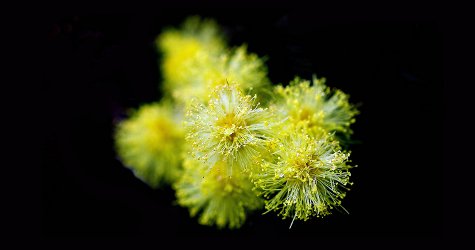
I have always liked mimosa in fragrances. Rather, I should clarify: I have always liked Acacia farnesiana (cassie) and/or scents with heliotropin. The term “mimosa” is a bit of a moving target, even in botany, as there are about 400 species or cultivars of plants under this genus, mostly with pink or mauve flowers, in addition to many other shrubs or trees that produce poofy, cartoonish blossoms and were historically lumped in under the name by the public — silk tree being an example. The sweet, warm, powdery smell we encounter in perfumery, with its facets of almond, honey, violet, craft paste and fresh cucumber, comes from distillation of the soft, feathery yellow petal clusters of the acacia species that most of us in the West know as mimosa flowers. One of my most vivid and happy memories of visits to France is the bushels of mimosa branches tossed out during “La Bataille de Fleurs” or flower parade during the Carnaval de Nice, which winds its way along what must be one of the world’s most beautiful thoroughfares, the Promenade des Anglais.
For all its cheerful straight-forwardness, mimosa appears to be a hard note to use in perfume. There are very few credible soliflores and many mainstream fragrances with a strong mimosa presence come off as airheaded and shampoo-like. With the IFRA restrictions on heliotropin, it has become even more difficult, if not impossible, to base a fragrance around the flower. Looking to include perfumes with some availability in this list, I found that almost all the mimosa fragrances I’d enjoyed at the beginning of my perfume education in the mid-noughties were discontinued or reformulated. Caron Farnesiana, long the great classic of mimosa perfumes, has gone through so many versions that it is hard to keep track of them all…
Read the rest of this article »
Posted by Angela
on
4 April 2011


Mimosa fragrances must be tricky to pull off. There aren’t a lot of them out there. Besides Parfums de Nicolaï Mimosaique which I’m reviewing today, Caron Farnesiana, Guerlain Champs Elysées, and L’Artisan Parfumeur Mimosa Pour Moi seem to hold the field. (The jury seems to be still out on Annick Goutal’s limited edition Le Mimosa that Kevin reviewed last week.)
Or maybe mimosa just isn’t a very popular note. The milky almond sweetness of mimosa mimics heliotrope, and not everyone’s a fan. I read lots of comparisons of heliotrope to “plastic doll head,” for instance. Me, I love the smell of both heliotrope and mimosa, and I adore the fresh, warm ease of Parfums de Nicolai Mimosaique Eau de Parfum…
Read the rest of this article »
Posted by Kevin
on
30 March 2011

I love the smell of mimosa flowers (Acacia pravissima is blooming in my garden now). For me, the “perfume” that best captures the floral scent most of us associate with “mimosa” (Acacia dealbata) is Diptyque Mimosa room spray. I’ve loved many of the Annick Goutal floral fragrances, and I hoped Le Mimosa would provide a mimosa scent I could wear on my skin, not simply spray into the air.
Le Mimosa, developed by perfumer Isabelle Doyen, lists fragrance notes of peach, anise, iris, mimosa, sandalwood and white musk. Le Mimosa opens with a dry, flat note that smells like a combination of pencil shavings, cumin powder, and ‘hairy’ leather. This slightly “dirty” aroma marches thru the entire composition…only soap will remove it from skin. As Le Mimosa develops, I smell artificial “peach” and I detect, for a split second, a puff of iris, a speck of anise, and some vague “citrus.”
There’s plenty of white musk and the aforementioned “peach” in Le Mimosa’s base, but none of Le Mimosa’s notes produces a scent with the aroma of fresh mimosa blossoms (if that’s what you are looking for or expecting). What mimosa there is in Le Mimosa is faint…
Read the rest of this article »
Posted by Jessica
on
5 November 2010

Earlier this year, Amouage released its Library Collection, a trio of fragrances designed as a “poetic homage to the art of living.” Opus III is a floral oriental developed by perfumer Karine Vinchon; according to Amouage, this fragrance “was inspired by the art and science of the creative process, from the darkest moments of frustration, to the brightness of enlightenment and discovery.” It includes top notes of mimosa, broom, carnation, nutmeg, and thyme; a heart of violet, jasmine, ylang-ylang, and orange blossom; and base notes of ambrette, musk, papyrus, cedarwood, sandalwood, guaiac wood, benzoin, and vanilla.
Opus III opens with a distinctive note of broom flowers. If you’ve ever tried Santa Maria Novella Ginestra, a broom soliflore, you’ll recognize this scent, something like cut hay and long grass warmed by the sun. If Opus III were visible as color, the dominant shades of its opening and its heart would be the bright, almost sharp yellow of broom blossoms and the buttery shade of mimosa flowers…
Read the rest of this article »