Every February, we consumers are reminded in many not-so-subtle ways that the rose is the flower of romance, and that we should be buying roses, giving roses, and wearing roses in all their forms. I happen to believe that rose fragrance is a perfect choice for any day of the year, not just Valentine’s Day, but I’ve decided to wear and review some recent and new rose releases all the same. One is a 2011 launch from the classic house of Caron, and the other is the latest offering from A Dozen Roses, a new niche collection that was itself founded in 2011.
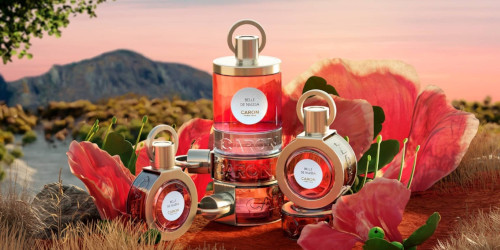
Caron’s Délire de Roses Eau de Parfum is described as “an exquisite concoction…redolent of a spring garden in full bloom,” with top notes of blended rose petals and lotus flowers, a heart of lily of the valley and rosebush leaves, and a base of jasmine and lychee. It opens with a sheer cluster of rosebuds and lily of the valley, and it eventually dries down to a soft, fruity rose that stays close to the skin. Between these two floral phases, the fragrance’s mid-development is warmed by an unexpected salty-amber aquatic note. Since Délire de Roses has a transparent feeling and light staying power, it would work well as a rose fragrance for warmer weather. Other than that salt-breeze heart, it reminds me a bit of Crabtree & Evelyn’s Evelyn (now Evelyn Rose), one of my favorites during the early 1990s.
Overall, Délire de Roses is pretty and girlish and bright…
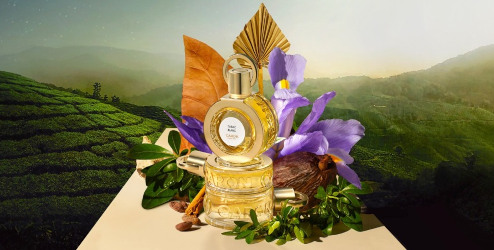
Farnesiana was one of the first modern fragrances inspired by the mimosa flower, that notoriously difficult-to-replicate fluffy yellow bloom. According to Jean-Marie Martin-Hattemberg’s volume on Caron, Farnesiana was created by perfumer Michel Morsetti in 1947; its composition includes notes of mimosa, black currant, bergamot, jasmine, violet, lily of the valley, lilac, vanilla, sandalwood, opopanax, hay, and musk (although the Caron website currently only lists mimosa, sandalwood, and hay). The name “Farnesiana” refers to acacia farnesiana, the botanical name for a particular variety of mimosa; it is also, Caron suggests, evocative of Rome’s grand Farnese Palace.
That juxtaposition of a simple flower and a Renaissance palazzo seems appropriate to me, since I’ve always considered Farnesiana a sophisticated comfort scent, an unusual floral-gourmand (or “fleurmand,” as I like to call this perfume sub-genre). To my nose, Farnesiana begins with a powdery, pollen-like mimosa note and with accords of sun-warmed hay and grass. Oddly enough, this green-tinged phase reminds me of certain fragrances from Santa Maria Novella, like Ginestra (Broom) or Fieno (Hay), that evoke meadow-like landscapes. Farnesiana’s heart opens up to reveal the sweetly resinous opoponax…
The last few months have not been easy. I’ve had unexpected news from the doctor; scary appraisals from the plumber and house painter; and my spirit-reviving winter vacation will be delayed. Oh, and a new operating system at work is making my hair stand on end for eight hours a day. If I ever needed a comfort scent, it’s now.
Many of my perfume-loving friends turn to “food-y” perfumes in times of woe, but I usually don’t enjoy gourmand fragrances. I’d rather eat cake and caramels, and drink hot chocolate for comfort than smell them on my skin. I opt for perfume simplicity in turbulent times — fragrances that play with, and display, just a few notes. A comfort scent shouldn’t be too powerful either; it must not “intrude” on calamity but buffer it.
For my current tempestuous cycle, I’ve opted for an oldie perfume: Caron Pour un Homme, a fragrance that debuted in the 1930s when lots of people around the world needed comforting…